
Radio Free Belfast broadcast 1969-1970.
This tape recorder was used to record the 24/7 live transmissions from the Pirate Radio Station Radio Free Belfast manned by Civil Rights and People’s Democracy members during 1969-70. A life line for the people behind the Barricades.These informative transmissions were mixed with humorous tongue and cheek Political Statements, Traditional Music Requests, Rent Strikes, Army Curfews and RUC Raids.
Written by Vincent Dargan, private collector
Stills captured from film clips of incidents from the Troubles edited by Peter Heathwood, 1970s – 1990s
These film clips of incidents from the Troubles show the everyday object, namely, a car, van or lorry used for the purposes of war. The incidents used cover all parts of Northern Ireland, London, and Manchester.
Written by Peter Heathwood, private collector
*None of these clips show incidents where anyone was killed or seriously injured.


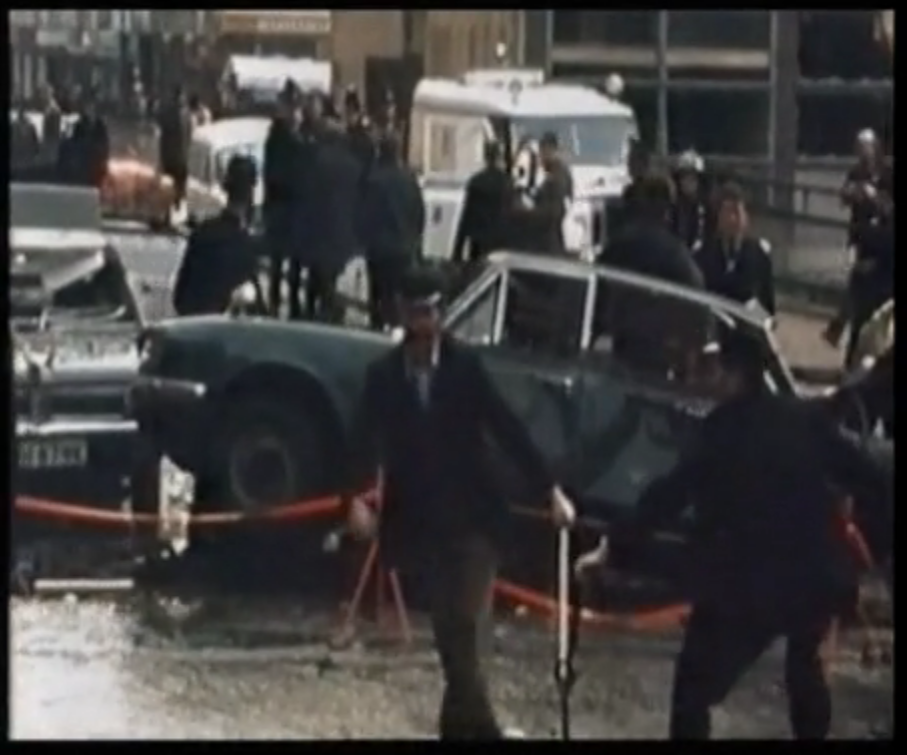


Everyday Objects Transformed by the Conflict – option 1 (portfolio)
Everyday Objects

Photograph of Model church
This matchstick model of the Ardglass Presbyterian Church was constructed by a Protestant prisoner at the Maze Prison in 1978.

Me at Fort Whiterock
The wall behind me which has been transformed by the mural shows a guards regiment with the union flag. The

Maiden City Festival flyer and poster
With Republican opposition to its annual commemorative events expressed through rioting, causing £millions of damage to Londonderry City centre, the

‘A year in the Black Taxis’ by Brendan Ellis
This series of twelve pictures depicts a range of people in the back of black taxis. The images are of

Captive verses
Those incarcerated at any of the prisons during the troubles were encouraged to take up a past time or hobby.

Behind the Barricade record
James Young was one of Ulster’s best known comedians. He used the medium of live stage and recordings to reach

Riot helmet
This was standard issue to all R.U.C. motorcycle police officers. It was however employed as head protection during the riots


Photograph of 11th Night Bonfire, Ballycraigy, Antrim, 2007
Constructed from wooden pallets and tyres, bonfires are part of Loyalist ritual. Bonfires are burned every year on the 11th
Everyday Objects Transformed by the Conflict – option 2 (masonry)
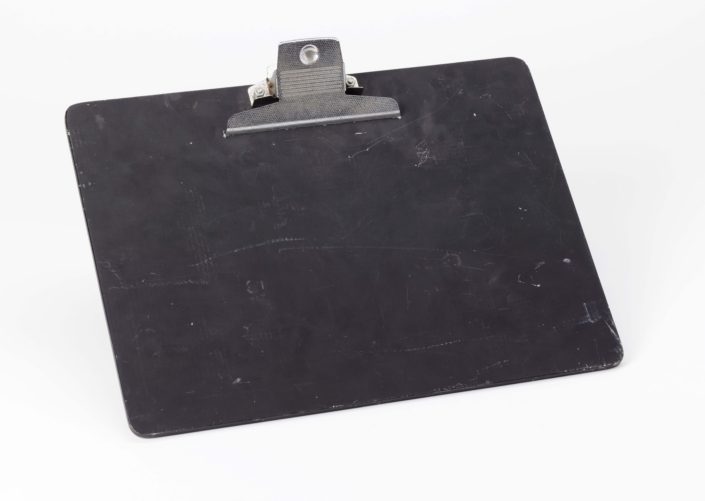
RUC armoured clipboard
This was used by police offices at vehicle checkpoints in ‘high-risk’ areas. The clipboard was intended to give protection to police officers if threatened with a handgun. It has a carrying handle and was designed to withstand small calibre bullets. It was used in the late 1970’s, but was never a success due to its weight and general bulkiness.
Label written by Hugh Forrester, Police Museum.
Label written by Hugh Forrester, Police Museum.
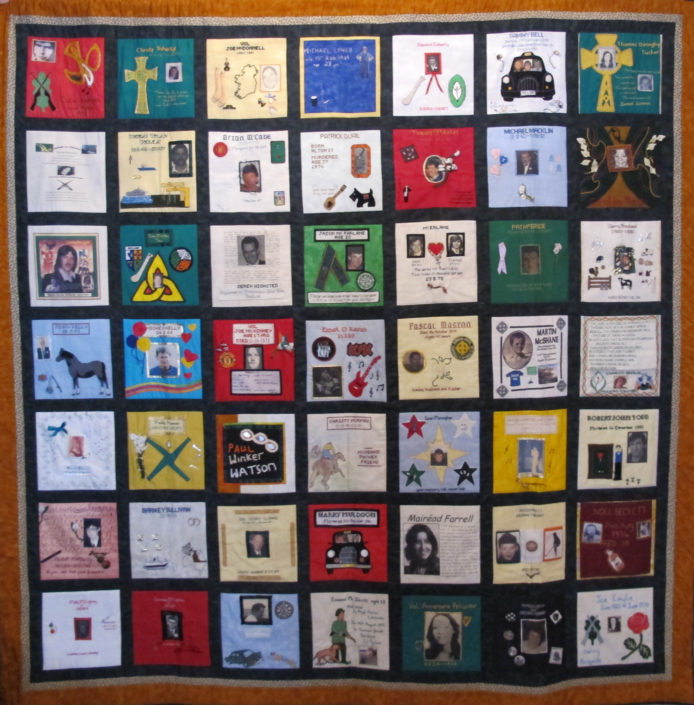
Relatives for Justice Remembering Quilt
Relatives for Justice Remembering Quilt is made up of squares which have been dedicated to individuals who have died as a result of the conflict. These squares are designed and made by family members and friends who wish to remember their loved ones in a creative and positive way. The squares are brought together to form a large quilt which will be a poignant remembrance of the great loss our community has had to bear.
Label written by Mark Thompson, Relatives for Justice.
Label written by Mark Thompson, Relatives for Justice.
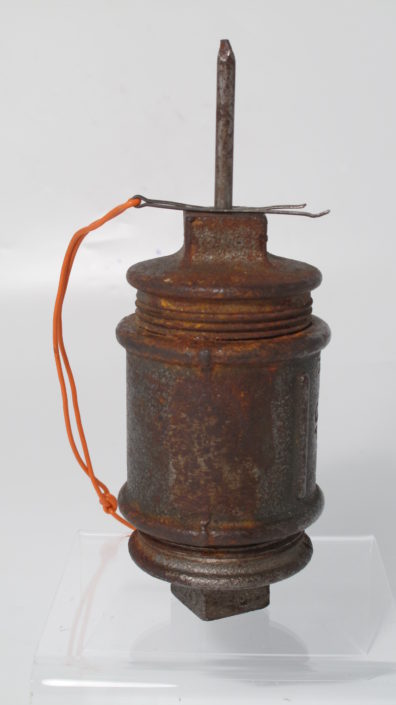
Photograph of IRA improvised grenade
This piece of standard plumbers pipefitting was combined with a four inch nail, a .22 cartridge and homemade explosives to manufacture an Improvised Explosive Device (IED). It was discovered, along with twenty eight similar IEDs, in Carrickmore Co Tyrone in February 1974. At the time the British Army was tasked with rendering safe IEDs.
Label written by John Blaney from REME Museum of Technology.
Label written by John Blaney from REME Museum of Technology.
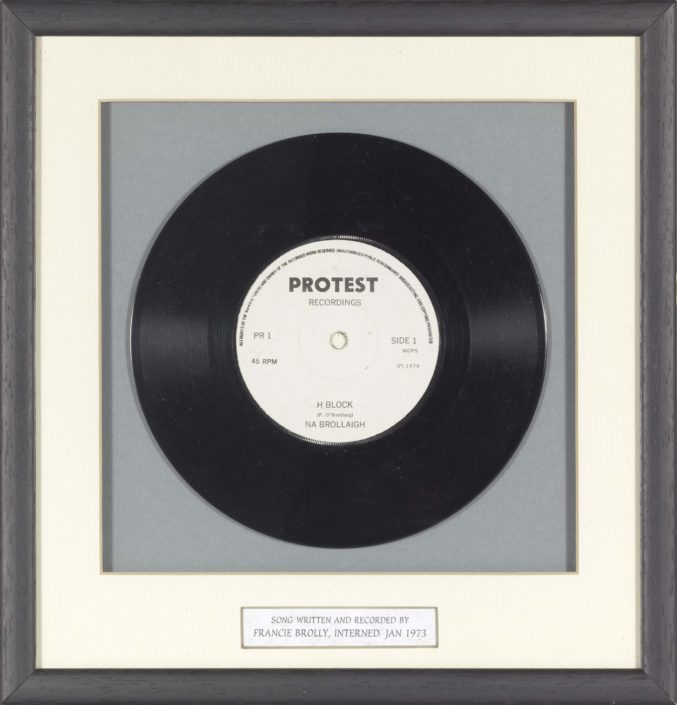
Framed record of ‘Wear no prison uniform’ by Francie Brolly, 1979
I wrote this song to raise funds for our local prisoners' support group. Basically, it tells the story of the huge and courageous part that was played by 'the felons of our land' in the struggle for Irish freedom, not just in our time either, and the certainty that the 800 years of a British campaign to colonise us would ultimately fail in the face of our heroic resistance.
Label written by Francie Brolly from Republic Museum, Dungiven.
Label written by Francie Brolly from Republic Museum, Dungiven.
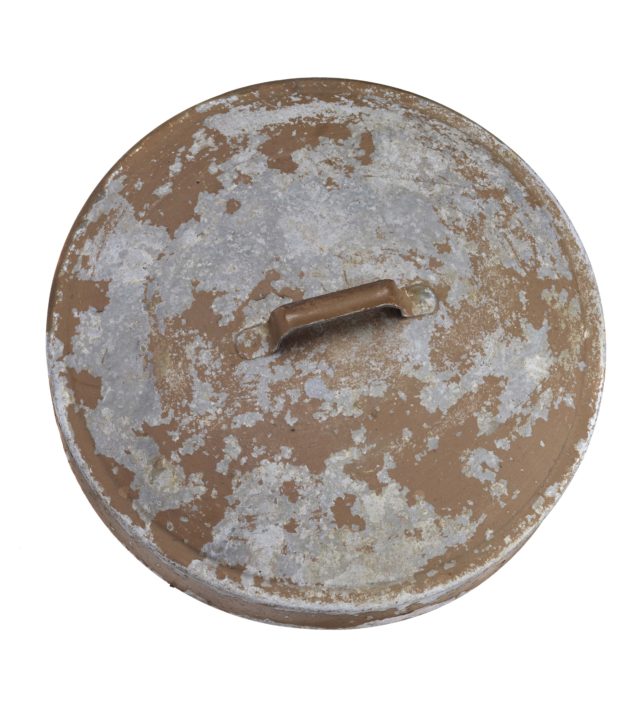
Binlid from West Belfast
A metal binlid to some was for covering a bin but for lots of nationalists and republicans it was a warning system. People mostly women would beat the binlid against the ground to warn I.R.A activitists either to engage the Brits or to find themselves safehouses. It just let the people know where the Brits were.
Label written by Pat McArdle from Roddy's Museum.
Label written by Pat McArdle from Roddy's Museum.
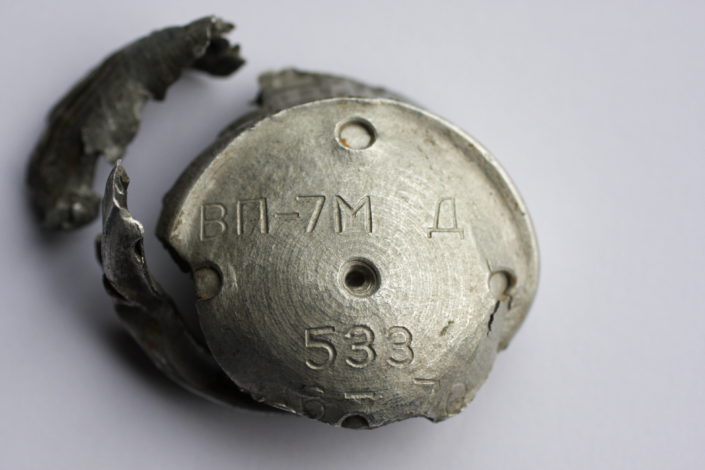
Nose cap of R.P.G.7 Russian anti tank grenade
On the 4th of July 1973 the Provisional I.R.A fired a R.P.G 7 at my foot patrol in the Creggan est Londonderry. It hit the wall above us and I was hit with shrapnel in the back of my leg virtually ending my army career. Not until thirty eight years later was this nose cap a memento of the attack given to me by an old platoon mate. A full account of this attack can be found in the book titled Bloody Belfast by author Ken Wharton along with many other soldiers stories.
Label written by Steve Norman.
Label written by Steve Norman.
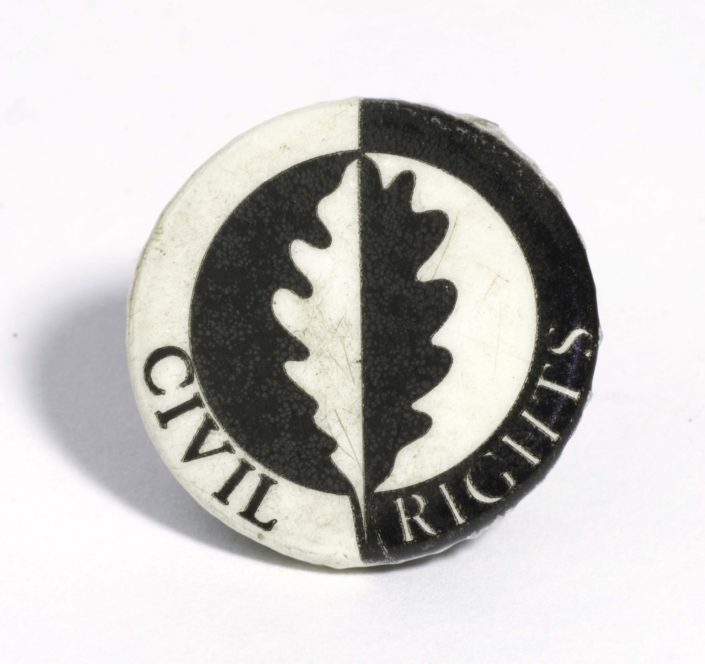
Derry Civil Rights badge
The Derry Civil Rights emblem was designed (in 1968) by Derry artist Sheila Mc Clean, wife of Dr Raymond Mc Clean, himself a civil rights campaigner in the city. The oakleaf recognises the ancient origins of the city’s name Doire, an oakgrove. Black and white were used to represent all persuasions and promote inclusiveness, white being the union of the rainbow colours and black the union of the same colours in pigment.
Label written by Michael McGuinness, the donator of the Derry Civil Rights emblems to Tower Museum, Derry ~ Londonderry.
Label written by Michael McGuinness, the donator of the Derry Civil Rights emblems to Tower Museum, Derry ~ Londonderry.
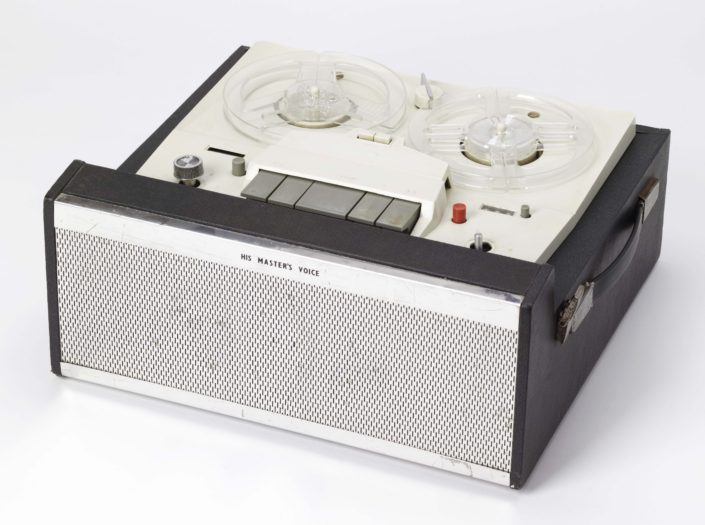
Tape recording machine
This tape recorder was used to record the 24/7 live transmissions from the Pirate Radio Station Radio Free Belfast manned by Civil Rights and People’s Democracy members during 1969-70. A life line for the people behind the Barricades. These informative transmissions were mixed with humorous tongue and cheek Political Statements, Traditional Music Requests, Rent Strikes, Army Curfews and RUC Raids.
Label written by Vincent Dargan, private collector.
Label written by Vincent Dargan, private collector.
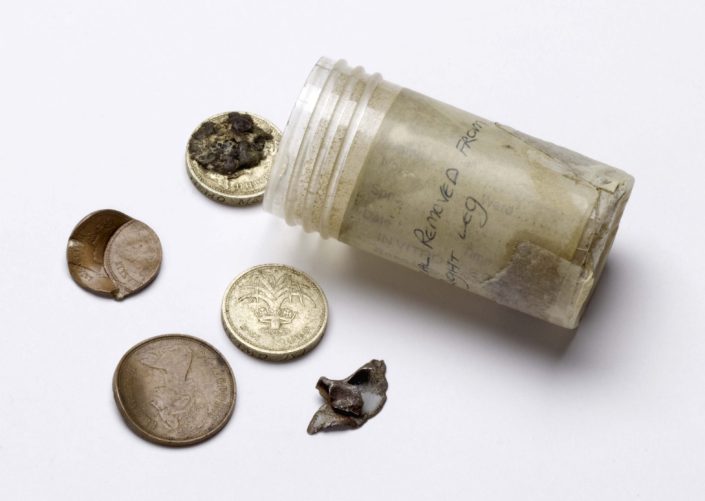
Shrapnel removed from the leg of Alex Bunting, 21st October 1991
Just as we got to the Boyne Bridge, a flash came out of the dashboard, a bit like a rainbow and I fell against the door which opened. It all happened so fast, I saw my leg come off and then I went out behind it and was blown across the street. I remember lying in the street fully conscious and my first thoughts were of Linda and the kids.
Label written by Alex Bunting in an extract taken from ‘Injured...on that day’ publication - WAVE Trauma Centre, Belfast.
Label written by Alex Bunting in an extract taken from ‘Injured...on that day’ publication - WAVE Trauma Centre, Belfast.
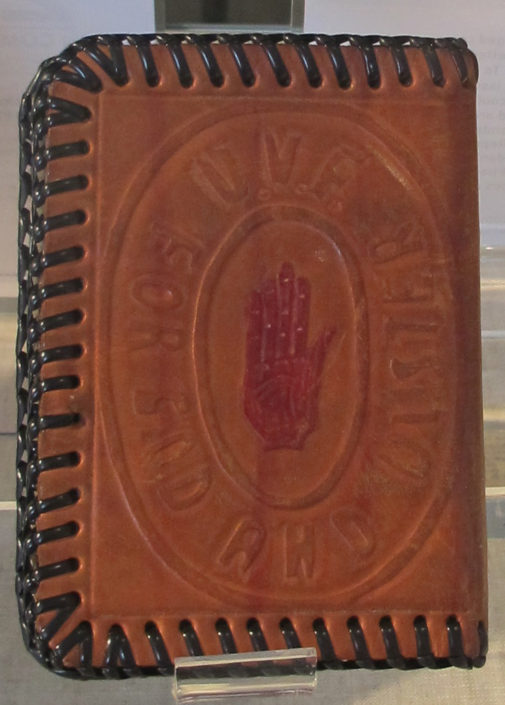
Wallet by Eddie Kinner P.O.W.
As Loyalist Prisoners settled into the POW style Camp in Long Kesh in their spare time they would create various handicrafts. The most popular form of handicrafts was leatherwork. Wallets, purses, belts, handbags etc. would be produced on request and sent on to customers on the outside. Prisoners became very skilful and developed their skills producing some of the finest Leatherwork over the years.
Label written by William ‘Plum’ Smith, EPIC collection.
Label written by William ‘Plum’ Smith, EPIC collection.
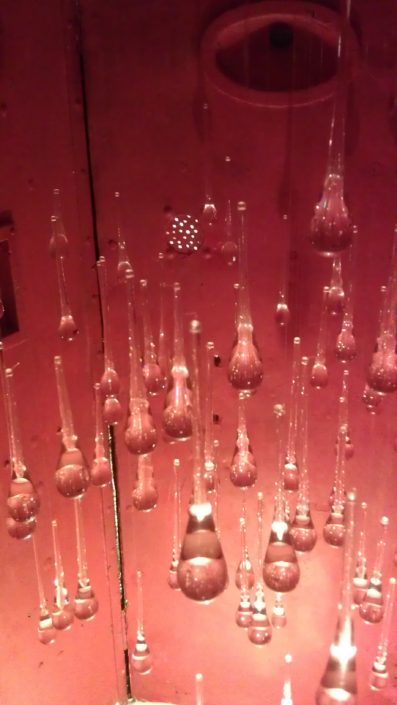
Rita Duffy Veil Mixed media, prison doors, salt and glass 2002
Rita Duffy has constructed a chamber out of prison doors taken from the former Armagh women’s Gaol. ‘Veil’ is a metaphor for the way that women’s lives have been shaped by conflict. They weep for husbands, brothers and sons caught up in a seemingly endless cycle of violence. The salt represents shed tears. The red interior recalls the participation of incarcerated women in the dirty protest, and the smearing of their menstrual blood on cell walls.
Label written by Zoë Lippett, Wolverhampton Art Gallery.
Label written by Zoë Lippett, Wolverhampton Art Gallery.
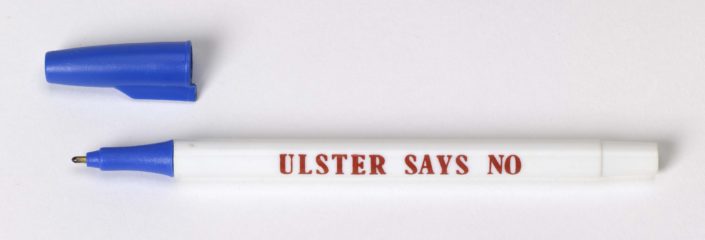
Pens
All shades of opinion tried to get their message across with embossed pens.
Label written by Peter Moloney, private collector.
Label written by Peter Moloney, private collector.
No posts found.